











|
| Appearances |
|
Please email us to verify appearances 72 hours (3 days) before making plans to
meet the Veterans at any future events. Appearances are based upon health conditions at time of show.
May 17th, 18th, and 19th
National Rifle Association Meeting
Kay Bailey Hutchinson Convention Center
650 s. Griffin Street, Dallas, Texas 75202

Norris Jernigan will be autographing our books and photographs at the annual meeting of the National Rifle Association Meeting held at the Kay Bailey Hutchinson Convention Center, 650 s. Griffin St. Dallas, Texas 75202. See us in the North Carolina Arms Collector booth number 10362. Appearance times 9 a.m. to 6 p.m. each day, Sunday 9 a.m. to 1 p.m. More more information visit the NRA website.
|
|
June 7th, 8th, and 9th
WWII Weekend
Mid Atlantic Air Museum
11 Museum Drive, Reading, Pa. 19605
For more Information please contact us or go to www.maam.org. Appearance times will 9 to 5 each day with the exception of Sunday which will be 9-12.
Norris prepared information for the flight crew missions to Japan. Norris is one of three remaining Veterans of the 509th. Due to his age Norris has informed us that these may be his last public appearances.
We will have books and photos available at both events for Norris to autograph. You can pre order Items from us up to a week before the events. You can contact us at Rwkrauss@hotmail.com.
|
|
Check back soon for more upcoming events!
Appearances are based on health at time of appearance so please check with us 72 hours before the show If you have a concern. We do not answer inquiries 24 hours prior to and during events.
Thank you,
Robert Krauss
Can't attend either event. Contact us to place an order for a book or photo autographed by these great men.
rwkrauss@hotmail.com
|
|
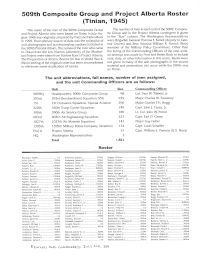
Trying to verify an individual was part of the 509th? Check out our updated roster.
Click Here!
Visit Our Collectibles section for a selection of rare and unique historical items that are not available anywhere else.
more...
509th Newsletter
Fall 2016
more...
Observations on
"Killing the Rising Sun"
more...


509th Veterans & families Outstanding Unit Award
more...
Los Alamos-Life on the Hill by Larry Johnston
more...
Paul Tibbets Interview by Studs Terkel
more...
Dropping The Atomic Bomb - By Richard Russell
more...
Limited Time FREE SHIPPING Offer
The 509th
Remembered

Here is the complete history of America's atomic bomb missions during WWII
|

;)
